
- 5 min read
- March 2026
What is Address Validation?
Rebekah Harkin
Address validation [address verification] is a process that ensures that an address is correctly formatted, complete, and exists within official postal databases, helping to confirm that mail or deliveries can reach the intended destination.
Key functions of address validation:
- Correctly formats address information to match postal carrier standards
- Fixes abbreviations, misspellings, and other inconsistencies.
Around 47% of newly-created data records have at least one critical error
The Difference Between Address Validation and Address Verification?
While the two terms are often used interchangeably, address validation and address verification refer to slightly different processes within the broader task of ensuring address data is accurate and usable.
Address validation is the process of checking that an address is correctly formatted, complete, and conforms to the expected structure for its country. It confirms that the address makes sense, that the postcode exists, that the street name is present, and that the data follows the correct address format. Validation can be done at the point of entry using tools like a postcode lookup API or address finder API, catching errors before they enter your system.
Address verification goes a step further. It not only checks that an address is correctly formatted but also confirms that the address genuinely exists and is deliverable. This is done by matching the address against an authoritative reference source such as the Royal Mail Postal Address File (PAF), producing a fully verifiable address that is recognised as a real, active postal location.
In simple terms:
- Address validation asks – is this address structured correctly and does the postcode exist?
- Address verification asks – does this address actually exist and can mail or parcels be delivered there?
Both processes work together as part of a wider data validation and data verification strategy. For UK businesses, combining postcode lookup with PAF matching covers both – ensuring addresses are not only correctly formatted but are also genuine, deliverable locations.
Why is Address Validation Important?
Address verification is an essential tool for any business that collects or acts on location data. Getting it wrong at the point of entry leads to problems that are far more expensive to fix later than to prevent upfront.
A customer’s address must be correct for a business to accurately process and fulfil an order, yet it remains one of the most common pieces of information to be entered incorrectly.
By incorporating data validation, the result is fewer returned packages, fewer failed deliveries, and happier customers who receive their orders in the right place, at the right time.
Address validation also helps a business run smoothly by preventing fraud, which can lead to expensive consequences and loss of revenue. If suspicious address information is entered, data validation acts as another line of defence, detecting duplicity and flagging undeliverable or fictitious addresses before they create risk.
What Are The Benefits of Address Validation?
Whether you run an e-commerce store, a financial services platform, or a direct mail operation, address validation is one of the most impactful tools in your business stack.
- Reduces failed deliveries: Validated addresses matched against sources like the Postal Address File (PAF) ensure parcels and correspondence reach the right destination first time, cutting the cost of returns and redeliveries.
- Improves data quality: Address validation prevents typos, incomplete entries, and incorrectly formatted addresses from entering your database, keeping your records clean and reliable.
- Better checkout experience: Tools like postcode lookup allow users to find and confirm their full address in seconds, reducing friction at checkout and improving conversion rates.
- Prevents fraud: Verifiable addresses make it harder for bad actors to use fictitious or undeliverable locations during sign-up or at the point of purchase.
- Stay compliant: Many industries, including financial services and healthcare, require accurate customer address data to meet regulatory and legal obligations. Validation ensures your records hold up to scrutiny.
Discover How Address Validation Can Support Your Business
The Types of Address Validation
There are several types of address validation, each serving a different purpose depending on the level of accuracy and verification needed.
Address Autocomplete [PredictiveAddress™]
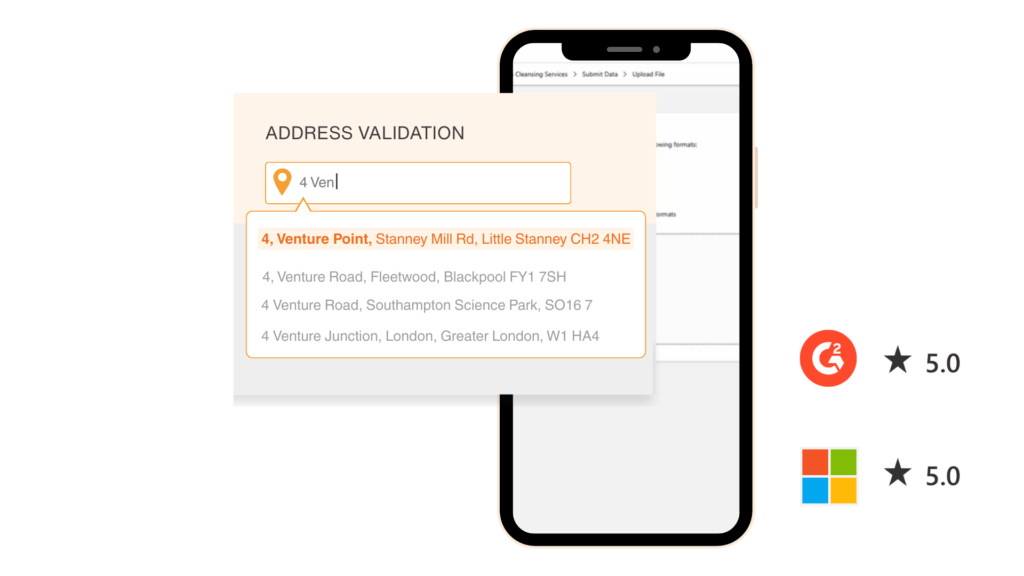
As a customer begins typing into the search field, address autocomplete generates a real-time drop-down list of matching addresses instantly appears, allowing them to select the correct result in seconds – ensuring that only clean, verifiable addresses enter your system.
Fuzzy Matching
Fuzzy matching validation finds close matches rather than requiring an exact match. Instead of rejecting an address simply because it contains a typo, an abbreviation, or a slightly different format, fuzzy matching compares the input against known address data and returns the closest likely match.
For example, if a user types “ 4, Venyure Pint” instead of “ 4, Venture Point “, fuzzy matching recognises the similarity and suggests the correct version rather than returning no result at all.
Postcode Lookup
Postcode lookup provides a customer with a list of addresses to choose from after a valid UK postcode has been entered. Using the same trusted database as PredictiveAddress™, results are sourced directly from the Royal Mail Postal Address File (PAF), which is updated daily to ensure every address returned is accurate, complete, and deliverable.
What Data Sources Are Used for Address Validation?
The accuracy of any address validation or address verification solution depends entirely on the quality of the data sources behind it. Data8 maintains data independence, meaning we are not owned or influenced by any single data provider, giving access to the widest range of high-quality data sources available.
The key data sources used to power address validation and postcode lookup:
- Royal Mail Postal Address File (PAF) — The gold standard for UK address lookup and address verification. PAF contains all known delivery points and postcodes in the UK, making it the most authoritative source for confirming that an address is genuine and deliverable.
- Multiple Residence Data — Used alongside PAF to identify individual dwellings within shared properties. With over 800,000 records covering 185,000 divided properties, this ensures apartments and flats are correctly identified during address search.
- Not-Yet-Built Data — Enables businesses to validate and deliver to addresses still in planning or construction stages, covering more than 500,000 records of new build properties.
- Ordnance Survey AddressBase — A comprehensive database of all known UK addresses, each linked to a Unique Property Reference Number (UPRN) for precise location matching and address verification.
- Eircode — Ireland’s official database of unique identifiers for all Irish addresses, covering 2.2 million business and residential addresses and powering Irish address finder and postcode lookup services.
- United States Postal Service (USPS) — Used for international address validation across the US, containing address change records to keep contact data accurate and up to date.
- National Change of Address (NCOA) — Tracks individuals who have recently moved and registered a new address, ensuring address data remains current and deliverable.
Together, these sources ensure that whether you are performing a UK address lookup, an international address validation, or a postcode lookup via API, the results returned are accurate, verified, and matched against the most up-to-date data available.