Why Address Validation APIs Are Critical for Data Quality and Business Performance

Poor address data costs UK businesses millions annually in failed deliveries, wasted marketing spend, and lost customer trust. When customers enter incorrect or incomplete addresses at checkout, the consequences ripple through your entire operation, from increased shipping costs and customer service calls to damaged brand reputation and lost repeat business. A UK address finder API solves this problem at the source by validating and standardising addresses in real-time as customers enter them.

Beyond preventing delivery failures, address validation APIs are fundamental to maintaining data quality across your entire organisation. Inaccurate address data affects everything from marketing segmentation and campaign performance to financial reporting and compliance obligations. When your CRM, ecommerce platform, and logistics systems all rely on the same high-quality address data, you create a foundation for more accurate business insights, better customer experiences, and improved operational efficiency.

For organisations preparing for AI initiatives, address data quality becomes even more critical. Machine learning models and AI-powered analytics are only as good as the data they’re trained on, and address data is often the most error-prone information in customer databases. Implementing a robust UK address finder API ensures your data is accurate, complete, and consistent from the point of entry, creating the data integrity necessary for successful AI readiness and advanced analytics initiatives.

Choosing the Best UK Address Finder API for Accurate Customer Data

Essential Features to Look for in a UK Address Finder API — And How Data8 Delivers

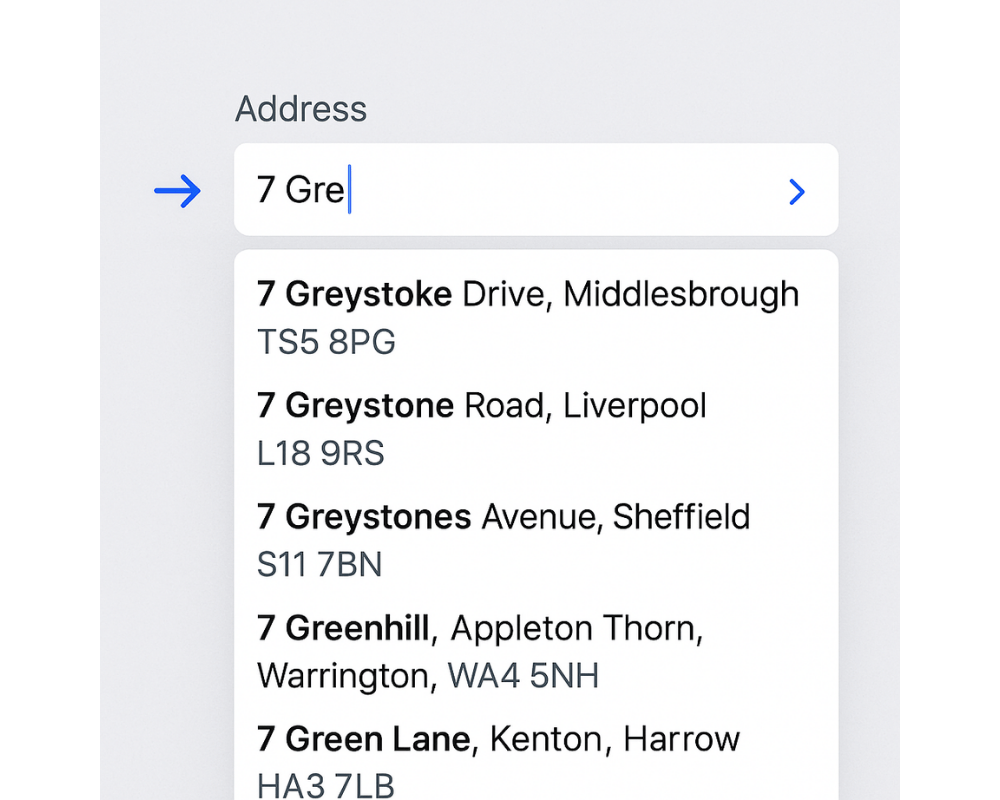
The most effective UK address finder APIs go far beyond postcode lookup. Our solutions offer predictive address technology, allowing users to start typing any part of their address, street name, house number, or postcode, and receive intelligent, real-time suggestions. This type-ahead functionality dramatically improves user experience by reducing form completion time and eliminating the frustration of scrolling through lengthy address lists. The best APIs such as Data8’s Address Validation solution uses fuzzy logic to handle typos and spelling variations, ensuring accurate address capture even when users make mistakes.

Dramatically improve user experience by reducing form completion time and eliminating the frustration of scrolling through lengthy address lists.

Data source quality is another critical consideration and something we are passionate about. Your API should access comprehensive, regularly updated UK postal address files from Royal Mail and other authoritative sources to ensure complete coverage across England, Scotland, Wales, and Northern Ireland. For businesses operating in Ireland, support for Eircode lookup and validation is essential to reduce failed deliveries and improve customer satisfaction. Unlike some of our competitors, we are not owned or influenced by any data provider, meaning we can offer the widest range of high quality data solutions.

To ensure your data is accurate, our API provides address standardisation, formatting addresses according to Royal Mail PAF standards to ensure consistency across your database and improve deliverability. 

Integration flexibility is equally important. Data8’s UK address finder API offers multiple integration options including pre-built connectors for popular CRM and ecommerce platforms like Microsoft Dynamics 365, Salesforce, and Shopify.

Our solutions provide comprehensive documentation, code examples, and technical support to reduce development time and accelerate time-to-value. For organisations with specific security requirements, we hold relevant certifications such as ISO27001 and maintain robust data protection practices to keep your data secure.

Try our Address Validation Tool - Free

Enter up to 15 addresses and try Address Validation for yourself! Remember, you can start from anywhere in the address
** Addresses are not stored or used for anything apart from this demo.

Real-Time Validation vs Batch Processing: Understanding Your Integration Options

Real-time validation and batch processing serve different but complementary purposes in a comprehensive data quality strategy. Real-time validation through a UK address finder API occurs at the point of data entry, whether on web forms, mobile apps, or within CRM systems, preventing inaccurate addresses from entering your database in the first place. This approach delivers immediate benefits: faster checkout experiences, reduced cart abandonment, improved first-time delivery success rates, and cleaner data from day one. For ecommerce businesses, customer-facing applications, and any scenario where data is captured directly from users, real-time validation is essential.

Batch processing, on the other hand, is ideal for cleansing existing databases, validating imported data, or processing large volumes of addresses that have accumulated errors over time. This approach allows you to validate, standardise, and enrich thousands or millions of address records in a single operation, identifying issues like moved addresses, deceased records, and formatting inconsistencies. Batch processing is particularly valuable during data migration projects, quarterly database cleansing initiatives, or when preparing data for marketing campaigns. Many organisations combine both approaches: real-time validation for new data entry and regular batch processing to maintain the quality of historical records.

The choice between these approaches, or the decision to implement both, depends on your specific use case, data volumes, and business priorities. Ecommerce businesses and organisations with high-volume customer interactions typically prioritise real-time validation to optimise conversion rates and reduce operational costs. Charities, financial services firms, and organisations with large legacy databases often benefit more from initial batch cleansing followed by real-time validation going forward. The most effective data quality strategies leverage both methods, using real-time validation to prevent new errors while systematically improving historical data through periodic batch processing.

How Address APIs Reduce Cart Abandonment and Improve Checkout Conversion

Cart abandonment remains one of the biggest challenges for ecommerce businesses, with complicated or lengthy checkout processes being a primary culprit. Address entry is often the most frustrating part of checkout—customers must remember their exact postcode, understand address formatting requirements, and correctly type multiple fields without errors. A well-implemented UK address finder API transforms this experience by allowing customers to find and select their complete address after typing just a few characters. This dramatically reduces form completion time, eliminates frustration, and removes a major barrier to purchase completion.

The impact on conversion rates can be substantial. When customers can complete address entry in seconds rather than minutes, and with confidence that their delivery address is correct, they’re significantly more likely to complete their purchase. Predictive address technology also works seamlessly on mobile devices, where typing lengthy addresses is particularly cumbersome. By reducing the number of form fields, keystrokes, and potential errors, you create a frictionless checkout experience that encourages completion. For businesses operating in competitive markets, this improved user experience becomes a competitive advantage that directly impacts revenue.

Beyond the immediate conversion benefits, accurate address capture through API validation reduces post-purchase problems that damage customer relationships and increase costs. When delivery addresses are validated in real-time, you eliminate failed deliveries, reduce customer service inquiries about missing orders, and avoid the substantial costs of reshipping or refunding orders. Customers who receive their orders quickly and reliably are more likely to become repeat purchasers and brand advocates. The combination of improved conversion rates, reduced operational costs, and enhanced customer satisfaction makes Data8’s UK address finder API one of the highest-ROI investments an ecommerce business can make.

Own Your Data Quality

Evaluating API Performance: Speed, Accuracy, and Data Source Quality

API performance directly impacts user experience and data quality outcomes, making it a critical evaluation criterion. Response time is particularly important for real-time validation, users expect instant address suggestions as they type, and delays of even a few hundred milliseconds can create noticeable lag that degrades the user experience. Look for UK address finder APIs that consistently deliver sub-second response times, even during peak usage periods. The best providers invest in robust infrastructure, global content delivery networks, and optimised algorithms to ensure fast, reliable performance regardless of traffic volumes.

Accuracy is equally critical but more nuanced to evaluate. Data8’s UK address finder API draws from comprehensive, authoritative data sources including Royal Mail’s Postcode Address File (PAF), multiple location intelligence providers, and regularly updated postal databases. The API can also handle edge cases like new developments, recently renamed streets, and rural addresses with non-standard formatting.

Beyond basic accuracy, you can evaluate how well Data8’s API handles real-world challenges such as using fuzzy logic to correct typos, parse addresses entered in non-standard formats and distingushing between similar addresses in the same area

Request your 14-day free trial to test Data8’s Address Validation solution with your actual use cases to assess accuracy in scenarios specific to your business.

Join the Conversation

Receive the latest news, views and hot topics directly in your inbox! Sign up below

Follow us on social media

Data8
Privacy Overview

This website uses cookies so that we can provide you with the best user experience possible. Cookie information is stored in your browser and performs functions such as recognising you when you return to our website and helping our team to understand which sections of the website you find most interesting and useful.